
Numerical Analysis of Topological Phase Transitions in the Haldane Model: Berry Curvature, Chern Numbers, and Edge States
Keywords:
Haldane model, chern insulator, berry curvature, chern number, Topological phase transitionAbstract
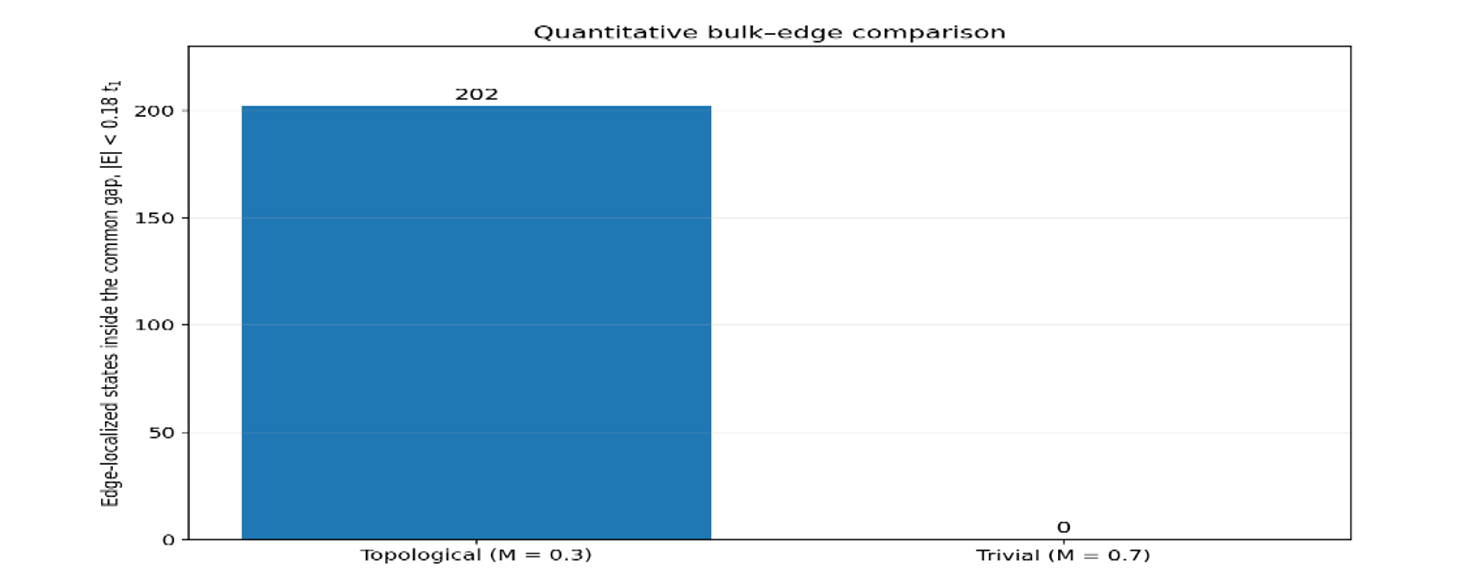
This study presents a numerical analysis of the topological phase transition in the minimal Haldane model using Berry curvature, Chern-number quantization, bulk-gap evolution, phase-boundary localization, and a finite-ribbon test of bulk-edge correspondence. The honeycomb-lattice Bloch Hamiltonian was evaluated with nearest-neighbour hopping t1=1, next-nearest-neighbour hopping t2=0.1, and a representative phase φ=π/2. The occupied-band Chern number was computed on a 122×122 Brillouin-zone mesh with the gauge-invariant Fukui-Hatsugai-Suzuki (FHS) method and cross-checked against a finite-difference Berry-curvature integral and a mesh-refinement test. For M=−0.3, 0.3, and 0.7, the calculated Chern numbers were −1, −1, and 0, respectively, with finite bulk gaps away from the transition, and the finite-difference curvature integral approached these quantized values as the mesh was refined. The critical masses, resolved on a scan step of 0.01 as M≈−0.52 and M≈0.52, agree with the analytical Haldane values ±3√3t2sinφ=±0.519615 to within the scan resolution (relative discrepancy 0.074%), and bisection on finer meshes converges toward the analytical values. Direct evaluation at the two inequivalent Dirac points confirmed the expected gap closures. A zigzag ribbon of 40 unit cells was then used to test bulk-edge correspondence. Edge-resolved ribbon spectra show one chiral branch on each edge crossing the common projected bulk gap with opposite velocities in the topological phase, and no state inside the gap in the trivial phase. Edge-localized states inside the common projected gap number 202 for M=0.3 and none for M=0.7, and the counts change once the window extends beyond the gap, so they are used as supporting evidence only. The results are a numerical cross-validation of the established Haldane transition and not the discovery of a new phase.
Published
How to Cite
Issue
Section
Copyright (c) 2026 Iyanuoluwa Olaniyi Ajayi, Samuel Oyindamola Adeosun

This work is licensed under a Creative Commons Attribution-NonCommercial 4.0 International License.
How to Cite
Most read articles by the same author(s)
- Samuel Oyindamola Adeosun, Joshua Owolabi, Ijeoma Ukorah, Rapheal Ugbe, Rabiu Tafida, Influence of ZnSe Donor Doping and Resistive Parameters on the Photovoltaic Performance of an MASnI₃ Perovskite Solar Cell: A SCAPS-1D Numerical Study , Nigerian Journal of Applied Physics: Vol. 2 No. 2 (2026): Nigerian Journal of Applied Physics - Vol. 2 No. 2
- Iyanuoluwa Olaniyi Ajayi, Simulation Of Quantum Spin Systems For Qubit Applications , Nigerian Journal of Applied Physics: Vol. 2 No. 3 (2026): Nigerian Journal of Applied Physics - Vol. 2 No. 3